You’re already paying for bad acceptance criteria. EthicGuard costs less than that bill.
EthicGuard grades every story’s acceptance criteria with AI the moment they’re saved, and keeps the ones nobody can test out of your sprint. Your backlog is read for one call and never stored.
Jira Cloud
Live
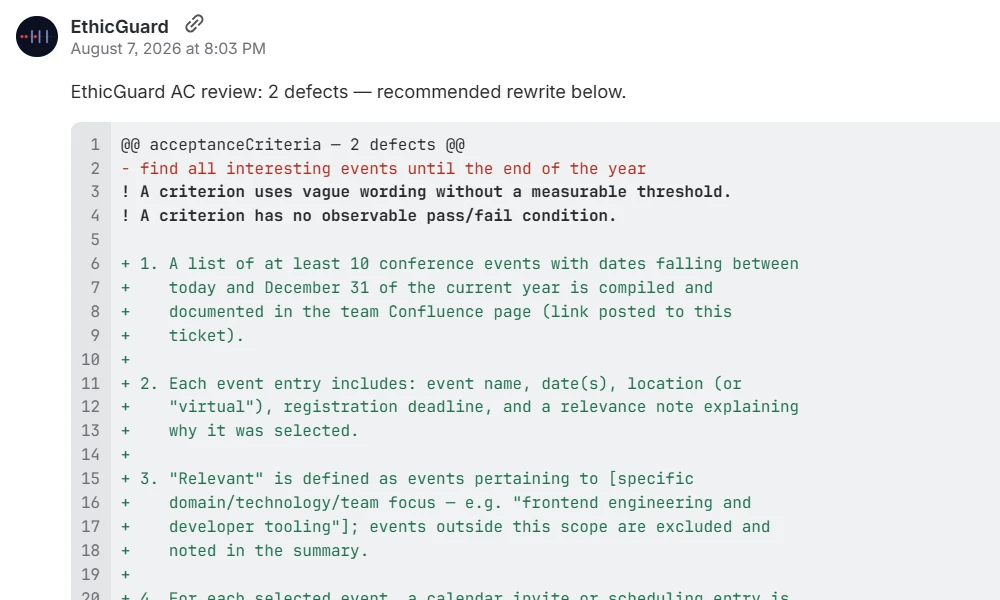
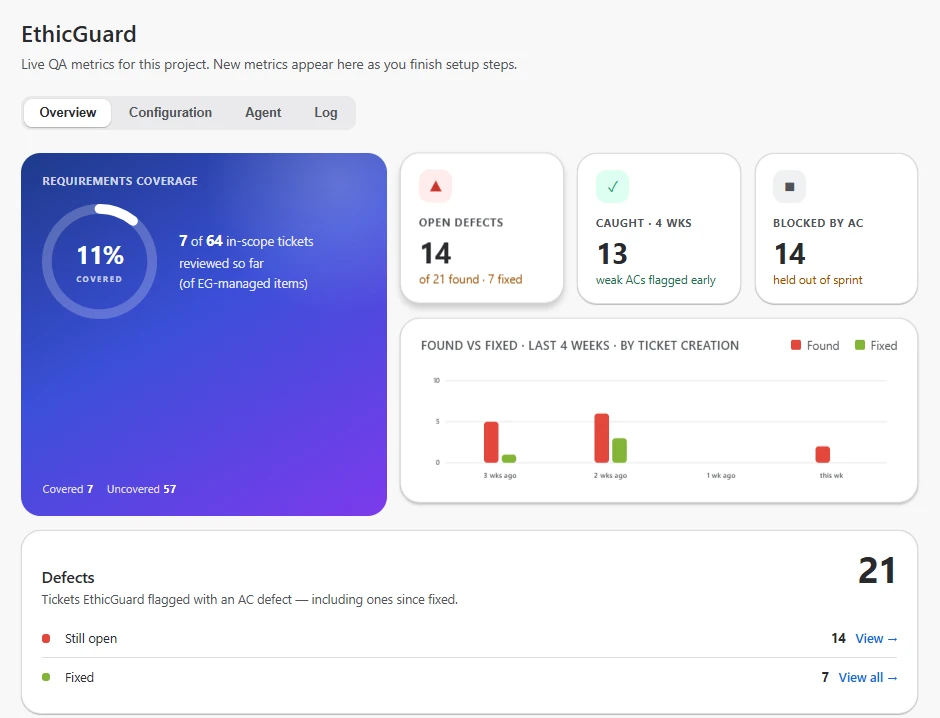
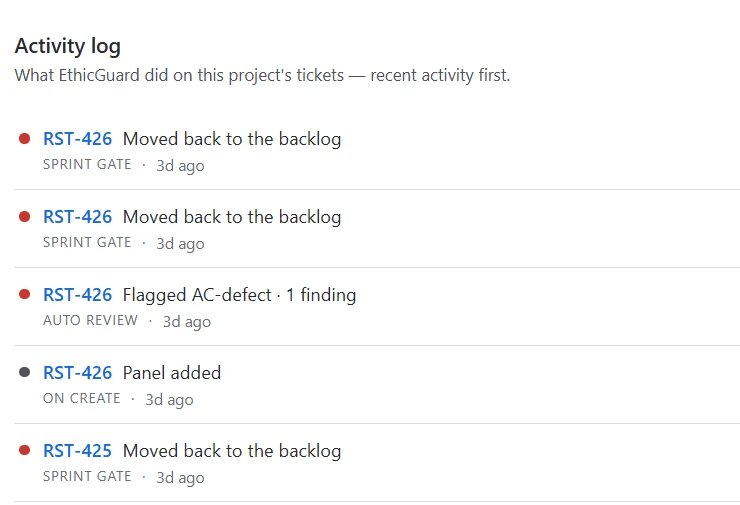
Verdicts land on the issue. The sprint gate holds back stories that fail your Definition of Ready.
Pick your role to see what EthicGuard does for you.
Works in Jira Cloud. Azure DevOps is coming on the same grading engine; early access on request.
We set it up with you, free.We connect EthicGuard in your project and train your team. Onboarding and support cost nothing, and you talk directly to the people who built it.
Set it once, then forget it.Nothing to maintain, nobody assigned to run it. It reviews every story and runs the sprint gate by itself. The only thing to keep alive is your AI key.
Rework is margin you already pay for.On fixed-price work, every requirement gap QA finds is unbilled hours. Over half of real user stories have quality defects (Lucassen et al., Utrecht, 2016: 1,023 stories, 18 companies).
Fix it at 1 hour, not 8.On average, a defect removed at requirements review costs about 1 staff-hour; one found at system test costs about 8 (Wagner, TU München, 2006).
A paper trail for client disputes.Every story enters the sprint with a verdict stamped on the issue. When a client blames you for a bug that started in the ticket, you can show the flag.
Passes your clients' security review.Stores none of your ticket content. Runs on your own AI key or your self-hosted model.
No new tool, no new process.Lives inside your tracker, 3-step setup, free for teams of 10 or fewer.
Protection in the AI-coding era.AI agents build exactly what the ticket says, so vague criteria now ship at machine speed. The gate sits before the agent.
Works in Jira Cloud. Azure DevOps is coming on the same grading engine; early access on request.
We set it up with you, free.We configure it to your team's Definition of Ready, in your own project, and walk your team through reading the verdicts. Support stays free.
Set it once, then forget it.No reviews to trigger, no queue to manage. Every story is checked automatically when it's created or edited, and the gate runs itself when a sprint starts.
Your Definition of Ready, enforced.It stops being a wiki page nobody reads. Unready stories go back to the backlog at sprint entry, with the reason.
You stop being the bad cop.The gate says "not ready", not you.
Fewer carry-overs, fewer mid-sprint clarification threads.Gaps surface in refinement, not in testing.
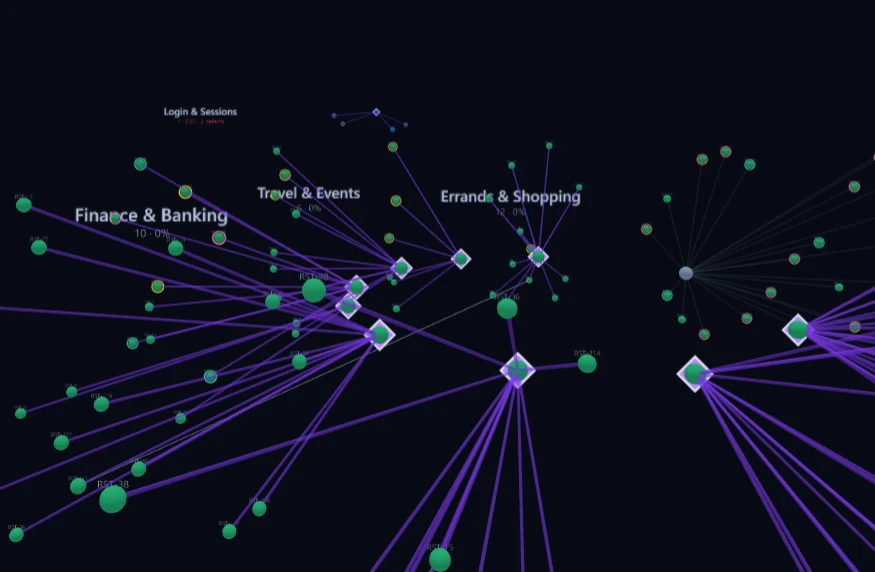
Readiness at a glance.Every story carries a verdict: verified, defect or not ready. Coverage shows on the project page and dashboard gadgets.
It doesn't nag your team.Only real defects block; improvements are advice. 0% false-defect rate on a published 75-story test set.
Works in Jira Cloud. Azure DevOps is coming on the same grading engine; early access on request.
Start every story knowing exactly what "done" means.
EthicGuard reads the acceptance criteria before you do, and sends the vague ones back.
No more "it works as written."If a criterion can't be tested, it doesn't reach your sprint. The ambiguity gets fixed in refinement, not in a code-review argument.
The gap, named.Not "this could be improved", but "AC-2 has no measurable threshold." One comment, on the issue, with the exact problem.
A fix you can paste.Every defect comes with a rewritten criterion in Given/When/Then. It's marked verified only after passing two fresh re-checks; otherwise it's labelled a draft.
It doesn't cry wolf.Defects block; suggestions stay suggestions. 0% false-defect rate on a published test set, because a gate that over-flags gets muted in a week.
Nothing to run, nothing to babysit.No CLI, no IDE plugin, no button. It reviews on its own when a story is created or edited.
Help when you wire it in.Free, hands-on setup support in your own project from the people who built it, not a ticket queue.
Your AI agent builds what the ticket says.Copilot, Cursor and Claude Code implement criteria literally. EthicGuard makes sure there's something precise to implement.
Your code and tickets stay yours.Ticket content is read fresh for each review and never stored. Use your own AI key or your own model.
Zero new tools.A label, a comment, a gate, all inside your tracker.
You don’t pay for EthicGuard. You stop paying for rework.
DevelopersFor a team ofdevsLoaded cost, per dev per year ($)atloaded each,Stories per dev per monthshippingstories per dev a month.EthicGuard bills $9.05 per user a month at that size, free up to 10 users.
EthicGuard ON: caught before code existsFlip it off to compare →
With EthicGuard
$37,333
avoidable rework left, per year
80 still reach your devs40 canceled
EthicGuard stops about one in three.
Without EthicGuard
$56,000
avoidable rework a year. 120 defects reach your developers.
You get back
$18,667
a year, from 40 defects caught at refinement instead.
Rework left
$37,333
a year, from the 80 defects that still get through.
License $2,172Adoption time 80 h · $5,333Net return $11,162 a yearROI 149% on $7,505 all-in
What one defect costs, by where it’s caught
relative to catching it at refinement
1×RefinementRefine
2×DevelopmentDev
3×Code reviewReview
5×QAQA
8×StagingStage
12×ProductionProd
Staff-hours per defect from
Wagner, TU München.
Field defects run to about 26×; we stop at 12×, and
Menzies et al.
found the real curve flatter still.
At your numbers, EthicGuard catches about 3.3 requirement defects at refinement each month: $1,555.58 of rework canceled. Twelve of those make $18,667, the You get back figure above.
960 stories/yr ÷ 8 = 120 defects
÷ 3 = 40 caught, 80 still reach development
40 caught × 7 h × $120,000 ÷ 1,800 h = $18,667/yr canceled
license $2,172 + 80 h reading reviews ($5,333) = $7,505 all-in
→ $11,162 net, 149% return
17 catches cover the year
1 in 8
stories carry a requirement defect
Utrecht University
analyzed 1,023 user stories from 18 organizations and found 56% carried at
least one defect; their earlier manual pass put it at 24%. We model 1 in 8, well
under both, because those studies count structural writing smells, most of which
are cheap to fix, and we count only defects severe enough to cause rework.
Ours · reasoned, not measured
No study reports 12.5%, and we attribute it to nobody. The quantity our model
actually needs has never been measured; a rate from real AC-defect labels will
replace it and will beat every citation on this page.
1 in 3
of those, caught before development
Porter, Votta & Basili
(University of Maryland, IEEE TSE, 1995) measured requirements inspection finding
between 24% and 57% of faults. We sit near the bottom of that band: EthicGuard
is an automated grader, not a trained inspection team.
Duisburg-Essen
ran an LLM over 1,266 annotated Mercedes-Benz requirements and got recall above 0.98
at precision near 0.55: it sees nearly everything and over-reports badly, which is
exactly why a human keeps the final say. The other two thirds are the Rework left
figure.
7 h
extra work when it surfaces late instead
Only the difference is counted: writing the criteria costs something either way.
A single-digit multiple, not the "100× after release" curve: that curve is challenged by
Menzies et al.
(NC State / SEI Carnegie Mellon / Fraunhofer, 2017), and the 1:10:100 figure most
calculators quote traces to no primary source at all.
Wagner (TU München, 2006)
puts removal at 1.06 h at requirements review and 8.37 h at system test,
a 7.31 h delta, which is where our 7 comes from. Two caveats we would rather state
than have found: that paper is a literature survey, not a primary measurement, and it
compares techniques rather than following one defect through time.
Frattini et al. (2023)
reviewed 57 papers and found this cost is reported in 15.8% of them and
“never determined empirically”. Nobody has measured it, us included.
Hours per developer-year are taken as 1,800, after leave and non-project time.
$9.05
per user per month
List price on the
Atlassian Marketplace.
The ladder is marginal, not flat: a 250-user site pays 100 × $9.05 plus
150 × $7.65, not 250 × $7.65. This page walks that ladder rather than
multiplying by a headline rate, so it can never quote a price the listing does not
charge, and sites of 10 users or fewer pay nothing at all.
5 min
per story, to read the review and act on it Ours · unmeasured
Counted as a cost, because it is one. Against the license alone, the return would read 759%: arithmetically true, and the same meaningless number every vendor calculator produces by dividing savings by list price.
Adopting a tool that reviews 960 stories a year
is not free because the software is cheap. Five minutes is generous to the cost side:
most verdicts are a clean pass. No study publishes this: it is ours to measure from
real usage, and it should be replaced the moment we can.
To review a story, EthicGuard sends its text to our analysis engine for a
single call, then discards it. We never store titles, descriptions,
acceptance criteria or comments. Azure DevOps will ship under the same rule.
No backlog text in our database, ever
Analyzed in memory, then discarded
Per-installation cryptographic isolation
Audit log for every analysis run
What we keep, and what happens if you uninstall
Only structured findings (anchors, scores, and message keys) are kept,
so the UI re-fetches your live Jira content whenever it renders. If you
uninstall the app, there's nothing left to recover. This website uses
Google Analytics for aggregate visit statistics; your Jira content is
never part of that.
Read the full privacy policy.
One plan. Everything included.
On Jira, billed through Atlassian alongside your subscription. No separate
vendor contract. Azure DevOps pricing comes with its launch.
Standard
$9.05per user / month
30-day free trial
Free for teams of 10 or fewer
Verdicts, gadgets, sprint gate, requirements map
Bring your own AI key: Claude, OpenAI, Gemini or self-hosted